Tchaikovsky
www.tchaikovsky-research.net
Souvenir de Florence
Dear researchers
First I must say that I admire your work on one of my favourite composers. There is one little problem that you didn't solve for me: you describe Souvenir de Florence as a string sextet, but I only know it as a works for string orchestra. Is this Tchaikovsky's own arrangment, or someone else's? From what year is this arrangement'?
Up to know I failed to find a picture of P.I.T.'s villa near Firenze, Tuscany. I would very much like to see the house. Could you include a photo, however meager, in you answer?
Thans you in advance
Hans de Jongste
Schiedam / The Netherlands
The Souvenir de Florence was written by Tchaikovsky for String Sextet (2 violins, 2 violas and 2 cellos), and that is how it was performed and published in Russia during his lifetime. The earliest performance by a string orchestra seems to have been on 13 January 1893 at Carnegie Hall, New York, conducted by Anton Seidl. But no special arrangment is required to adapt the work for string orchestra — it can be done by dividing the viola and cello sections into two halves, accompanied by the first and second violins.
I don't know if a picture is available of Tchaikovsky's residence in Florence that inspired the work, but if I find one then I will post it here.
Brett Langston
www.tchaikovsky-research.net
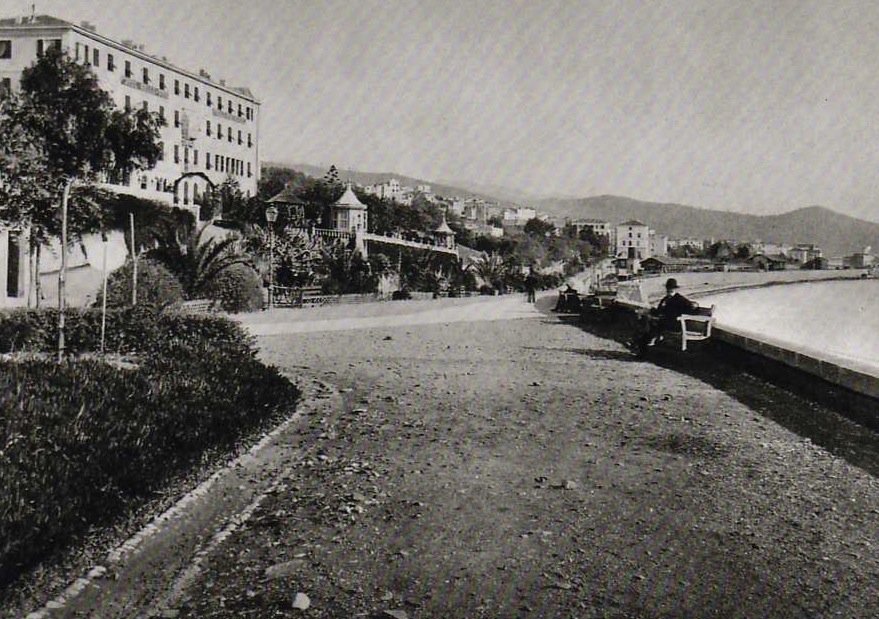
Tchaikovsky's sextet Souvenir de Florence was composed mostly in June-July 1890 at Frolovskoe (near Klin), where the composer rented a house. He had spent the first three months of 1890 in Florence working on the opera The Queen of Spades. He stayed at the Hotel Washington in Florence, and here is a picture of the composer sitting on the bench near the river and hotel.
Alexander Poznansky
I always feel it is a mistake to play the Souvenir de Florence on a string orchestra. I looses all its rythmic excitement and invites comparison with the Serenade for Strings, which is in all but name a symphony. The greatness of the work lies in the medium and its gritty sound. On an orchestra it sounds slushy and becomes a weak companion to the Serenade.
All Tchaikovsky's chamber works are masterpieces in my view, including the early B flat quartet. It is a pity he wrote no more quartets after the Fourth Symphony. Quartets 1 to 3 are I think the true precursors to the late syphonies; more so than the early symphonies, they contain great pyschological depth and have convincing musical structure. In material and message No 3 is the prelude to the Fourth Symphony and may even be greater. It is concise and free from melodrama and a true spiritual journey, culminating in a finale that is both vigorous and menacing. No 2 is astonishing in its fluency, wit and excitment. No 1 is, like Beethoven's 7th, a masterly essay in rhythm.
Norman Armstrong
I had the opportunity to play the Souvenir of Florence last summer at a Orchestral Studies program, in a large string orchestra, and while I understand how some of it's nuance may get lost with the size, the piece is still one of extraordinary energy and power when performed with a string orchestra. The last movement of the piece is one of the most cathartic melodies that I've ever played.
What is also of interest is how the Souvenir of Florence can hardly be called one of Tchaikovsky's most popular works, yet it is such an impeccable example of chamber music.
I am told that if someone wants to find the true persona of a composer look to the chamber music because it is often written for the composers closest colleagues and friends to perform. I'm aware that it was written for the Saint Petersburg Chamber Music Society in gratitude for making him a honorary member, and that work began on it, obviously during his trip to Florence. However, is that all that is to be said about it? Later on, did Tchaikovsky have any affinity for the piece that he didn't have for pieces like the "Overture to 1812" or "The Nutcracker"?
Thanks for any help.
John. A. Miller